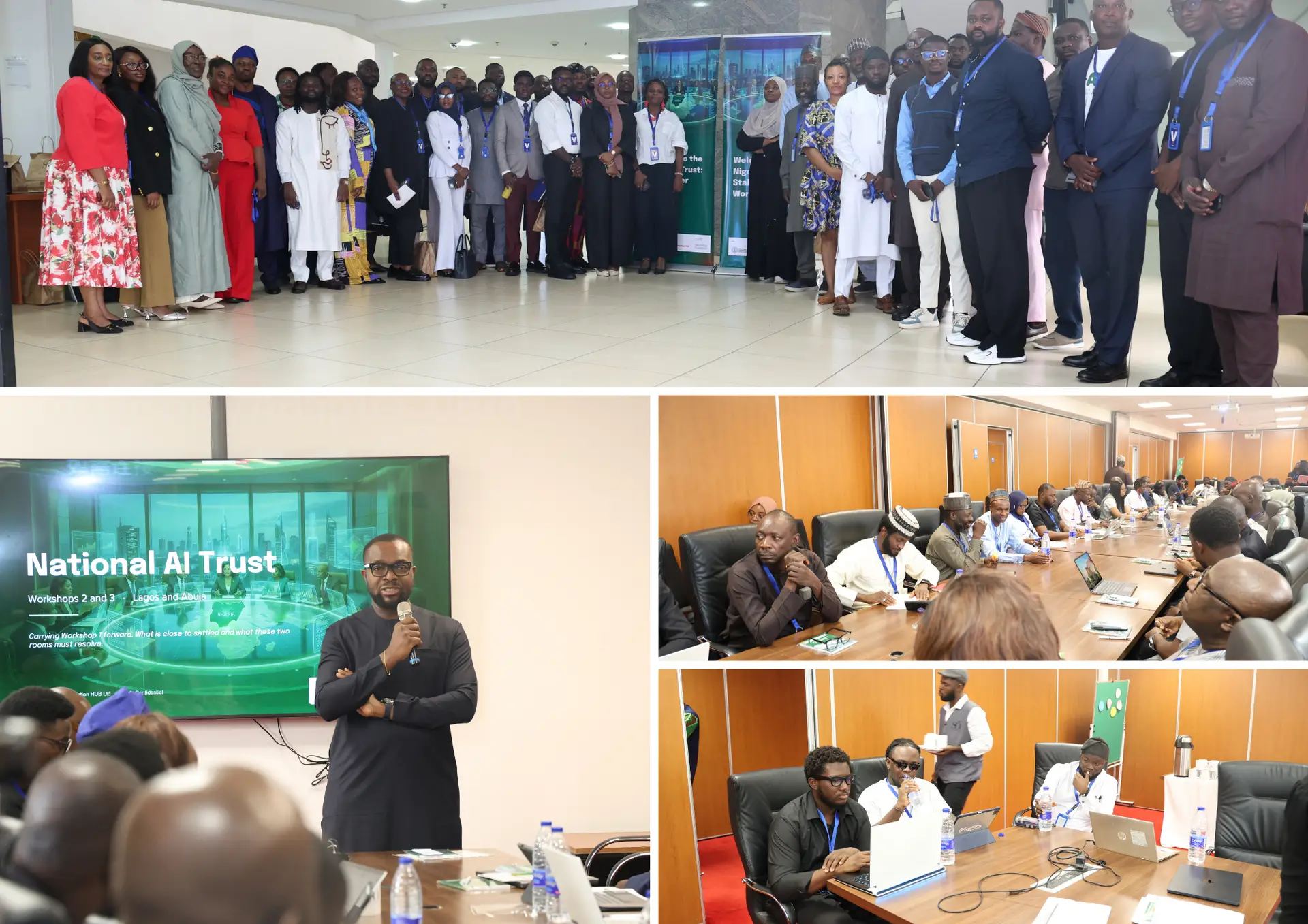
On the 4th of August 2026, the United Nations House in Abuja became a meeting point for an important national conversation about the future of artificial intelligence in Nigeria.
Government leaders, private-sector practitioners, academics, researchers, AI experts, legal professionals, development partners and civil society representatives gathered for the Nigeria National AI Trust Workshop, a convening designed to bring diverse perspectives together in shaping the mandate, governance structure and long-term direction of the proposed Nigeria AI Trust.
For us at DRISATECH, the workshop represented more than another technology policy gathering. It was an opportunity to participate in a conversation about how Nigeria can build institutions capable of guiding technological transformation responsibly, inclusively and sustainably.
From AI Strategy to Institutional Stewardship
Nigeria's AI journey has progressed considerably in recent years. The country has moved beyond conversations about whether artificial intelligence matters to discussions about how AI can be deliberately harnessed to drive economic development, improve public services, strengthen local innovation and position Nigeria within the global AI ecosystem.
The proposed Nigeria AI Trust represents an important next step in that journey.
The idea is to establish an institution capable of mobilising resources, providing strategic stewardship and helping ensure that the development and adoption of AI delivers broad economic and social value to Nigerians.
One of the most significant ideas emerging from the conversations around the Trust is institutional longevity.
Technology evolves rapidly, but institutions must be designed to endure. Nigeria therefore needs governance mechanisms that can maintain strategic direction even as administrations change, priorities evolve and political cycles come and go.
This was strongly emphasised by the Honourable Minister of Communications, Innovation and Digital Economy, Dr. Bosun Tijani, in his ministerial opening at the Abuja convening. His message was clear: the Nigeria AI Trust must become an enduring institution capable of sustaining progress and providing continuity for Nigeria's AI development.

Honourable Minister of Communications, Innovation and Digital Economy, Dr. Bosun Tijani at the Abuja National AI Trust Workshop, UN House.
That principle is particularly important because the decisions being made today will shape Nigeria's technological competitiveness for decades to come.
A National Conversation Built Through Co-Creation
The Abuja workshop was part of a broader series of convenings that began with a founding session in London in June and continued with engagements in Lagos on 29 July and Abuja on 4 August.
Rather than approaching the Trust as a predetermined structure, the convenings provided a platform for stakeholders to interrogate some of the fundamental questions that will determine whether the institution succeeds.

The Managing Director of CcHub, Ojoma Ochai
Among the central issues were questions around:
Theory of change: What should the Trust ultimately achieve, and how will its impact be measured?
Legal longevity: What legal structure can allow the institution to remain relevant and resilient across political and governance transitions?
Financial independence: How can the Trust secure sustainable resources without compromising its independence or public-interest mandate?
Selection legitimacy: How should trustees and other key actors be selected to ensure credibility, competence, diversity and public trust?
These are not merely administrative questions. They go to the heart of whether the Trust can become a credible national institution.
An institution designed to influence the direction of AI in Nigeria must itself demonstrate the values it seeks to promote: transparency, accountability, inclusion, independence, competence and long-term thinking.
Why Institutional Continuity Matters
Nigeria has experienced numerous policy initiatives that were ambitious at inception but struggled to maintain momentum across changes in leadership and government priorities.
The AI Trust presents an opportunity to approach this differently.
Artificial intelligence is not a four-year project. Its implications extend across education, healthcare, agriculture, manufacturing, financial services, national security, public administration, research and virtually every other sector of the economy.
Consequently, Nigeria's AI governance architecture must be capable of surviving political transitions.
The Trust should not become an institution of one administration, one ministry or one group of technology stakeholders. Its legitimacy will depend on its ability to serve a broader national interest.
This is why the conversations around legal structure, trustee selection, funding and governance are so important.
The institutional architecture must create enough connection with government to influence national priorities while maintaining sufficient independence to provide credible, long-term stewardship.
DRISATECH’s Perspective: Policy Must Translate into Implementation
As a multidisciplinary technology and engineering organisation working across technology integration, workflow systems, engineering and emerging digital solutions, DRISATECH was proud to contribute to this important conversation.
Our interest in the Nigeria AI Trust is rooted in a broader belief: technology policy is most valuable when it creates the conditions for real-world implementation.

National AI Trust Workshop
Nigeria does not merely need more strategies and policy documents. It needs institutions, systems, partnerships and implementation mechanisms capable of translating national ambitions into measurable outcomes.
Our experience in the iron and steel sector has reinforced this perspective.
I previously had the privilege of helping coordinate Nigeria's Iron & Steel Stakeholder Engagement, a process that brought together stakeholders to contribute to the development of the Draft National Policy on Iron and Steel Industry.
That experience provided an important lesson about policy development: bringing stakeholders together is only the beginning. The real challenge is creating a framework that can accommodate diverse interests, establish clear priorities and remain relevant as circumstances change.
That same lesson applies to AI.
The technology sector is exceptionally dynamic. New models, applications and capabilities are emerging at a pace that can outstrip traditional policy cycles. Nigeria therefore needs governance institutions that are sufficiently principled to provide stability while remaining sufficiently adaptive to respond to technological change.
From Iron and Steel to Artificial Intelligence
There may appear to be little connection between Nigeria's iron and steel policy and the country's emerging AI governance architecture.
But at a deeper level, both conversations are about the same fundamental question:
How can Nigeria build institutions and policies that enable strategic national development?
The iron and steel sector represents the physical foundation of industrialisation. Artificial intelligence increasingly represents a critical component of the knowledge and digital economy.
Both require long-term thinking.
Both require collaboration between government, industry, academia and other stakeholders.
And both require policies that can survive beyond individual projects, administrations and political cycles.
The stakeholder engagement process around the iron and steel sector eventually contributed to a broader policy evolution, with elements of that work feeding into Nigeria's evolving industrial policy landscape, including the **Industrial Policy 2025** unveiled by President Bola Ahmed Tinubu.
That experience makes the current AI Trust conversation particularly meaningful.
It demonstrates why stakeholder engagement should not be treated as a ceremonial exercise. When properly designed, it can influence the institutional and policy frameworks that shape a sector for years to come.
Building an AI Future That Includes Everyone
Another important dimension of the Nigeria AI Trust is inclusion.
Nigeria's AI future cannot be defined solely by large technology companies, government institutions or highly specialised researchers.
The benefits and risks of AI will extend to farmers, teachers, students, healthcare workers, engineers, entrepreneurs, civil servants, manufacturers, small businesses and communities across the country.
Nigeria also has an opportunity to ensure that African perspectives are represented in the global development of artificial intelligence.
As AI systems increasingly influence economic and social systems worldwide, countries that participate only as consumers risk having technologies shaped around contexts that do not adequately reflect their own realities.
Nigeria, as Africa's largest economy and one of the continent's largest technology ecosystems, has both the scale and the responsibility to contribute to the global conversation.
The Nigeria AI Trust could therefore become more than a national governance mechanism. If properly designed and effectively implemented, it could provide a model for how emerging economies can build institutions for responsible and inclusive AI development.
The Real Test Begins After the Workshop
Workshops are important, but institutions are ultimately judged by what happens after the conversations end.
The success of the Nigeria AI Trust will depend on whether the ideas generated through these engagements can be translated into a credible institutional framework.
Several principles will therefore be critical.
First, independence must be protected. The Trust should have sufficient autonomy to make decisions based on evidence and the national interest.
Second, accountability must be embedded. Independence without transparency can undermine public confidence.
Third, funding must be sustainable. An institution expected to provide long-term stewardship cannot depend entirely on short-term or politically contingent funding.
Fourth, trustee selection must inspire confidence. Competence, integrity, diversity and commitment to the public interest should be central considerations.
Finally, the Trust must demonstrate measurable value. Its continued relevance will ultimately depend on whether Nigerians can see tangible benefits from its work.
A Shared Responsibility for Nigeria’s AI Future
The National AI Trust conversation is ultimately bigger than government or the technology industry.
It is about the kind of technological future Nigeria wants to build.
Do we want AI development to be driven primarily by external forces, or do we want Nigerians to have a meaningful role in determining how these technologies are developed and applied?
Do we want institutions that respond only to today's challenges, or do we want institutions capable of anticipating tomorrow's?
And can we build governance structures that remain relevant even when today's political and technological environment has changed?
The Abuja workshop provided an opportunity to begin addressing these questions collectively.
For DRISATECH, participating in the conversation reinforces our belief that responsible technology development requires more than technical innovation. It requires sound institutions, thoughtful policy, multidisciplinary collaboration and a commitment to long-term national value.
Nigeria has an opportunity to shape an AI governance model that reflects its own realities while contributing to the global conversation.
The challenge now is to transform the ideas generated in London, Lagos and Abuja into an institution that earns public trust, attracts strategic partnerships, survives political transitions and delivers measurable value.
The future of AI in Nigeria will not be shaped by technology alone. It will be shaped by the institutions, policies and people we choose to build around it.
And that is why the Nigeria AI Trust matters.


Engr Idris Adeiza, Aliyu is a Materials Engineer, technology professional, data and AI enthusiast, and entrepreneur.
He holds both Bachelor and Master’s degree in Engineering from Ahmadu Bello University, Zaria, and is currently pursuing his second Master’s degree in Disaster and Risk Management. His interests include AI, Data Engineering, Business Intelligence, Sustainable Engineering, and Emerging Technologies.
Engr. Idris founded Drisa Engineering Solutions Limited and Drisa FarmDepot & Agric Solutions, developing practical engineering and technology solutions.
His writing explores AI, Data, Sustainable Engineering, Digital Transformation, and Technology Developments in Nigeria and Globally.