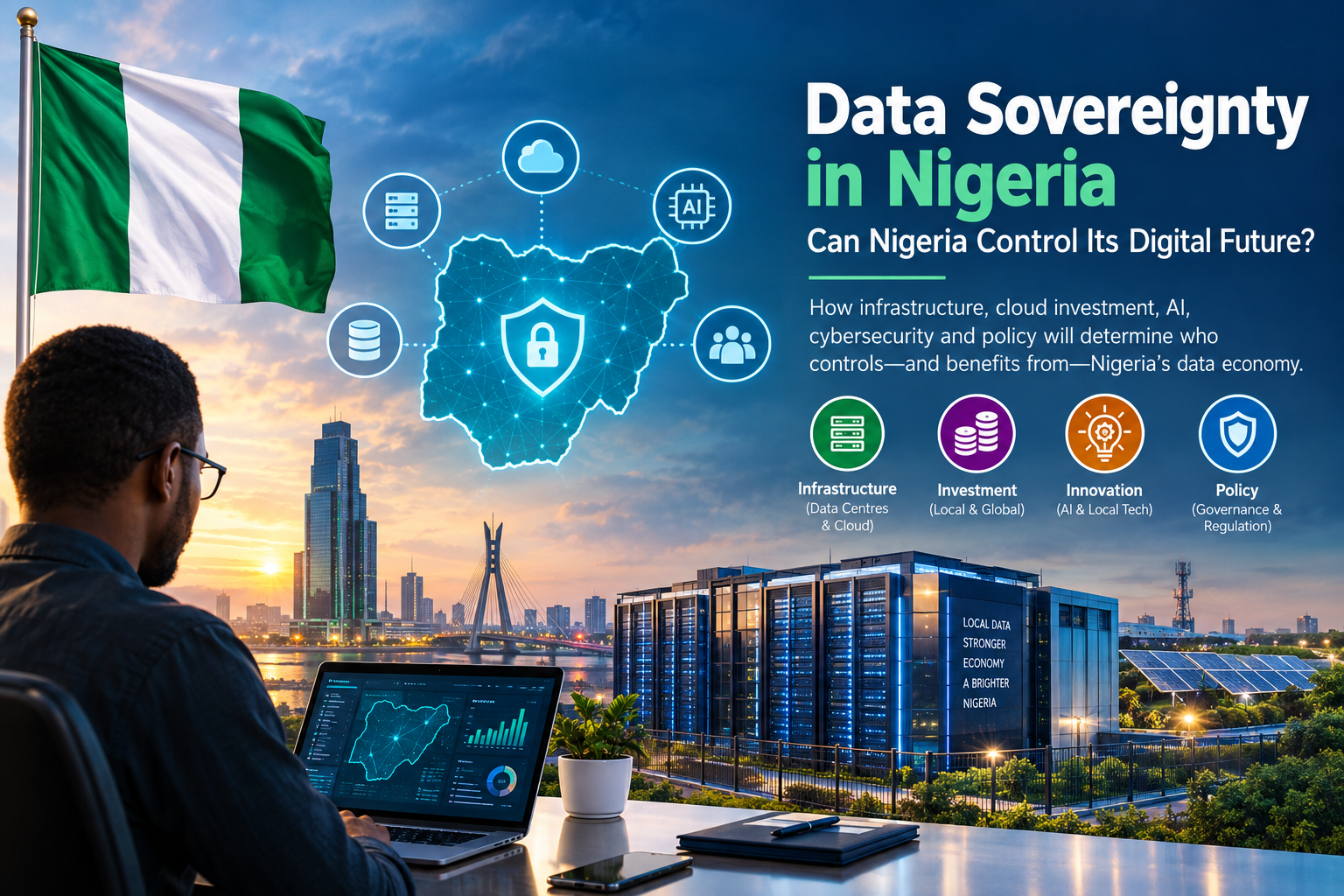
Nigeria is rapidly becoming a digital economy, generating vast amounts of data through banking, telecommunications, healthcare, government, commerce and artificial intelligence.
The key questions are:
Where is Nigeria’s data stored, who controls it, who can access it and who benefits from its value?
These questions define data sovereignty.
Data sovereignty does not mean digital isolation or keeping every byte inside Nigeria. It means retaining meaningful control over critical data, infrastructure, technology and economic value while remaining connected to the global economy.
Nigeria’s National Digital Cloud Policy is an important step. It promotes cloud investment and digital transformation while applying proportionate residency requirements to government and regulated data rather than imposing blanket localisation.
The challenge is turning policy into infrastructure, investment and innovation.
What Data Sovereignty Means
Data sovereignty has five dimensions:
- Location: Where is data stored?
- Jurisdiction: Which laws apply?
- Operational control: Who runs the infrastructure?
- Economic control: Who captures the value created from the data?
- Resilience: Can essential systems operate during cyberattacks, outages or geopolitical disruptions?
A Nigerian data centre alone does not guarantee sovereignty if the technology, software, encryption keys or cloud management remain controlled elsewhere.
Nigeria’s Main Challenges
Limited Cloud and Compute Capacity
Nigeria needs more data centres, cloud platforms, fibre networks, internet exchanges, cybersecurity systems and AI computing infrastructure.
In the AI era, sovereignty is not only about where data is stored, but also:
Who has the computing power to process Nigerian data and build the next generation of AI systems?
Energy and Connectivity
Data centres require reliable electricity and multiple connectivity routes. Digital sovereignty therefore depends on grid reliability, gas and renewable generation, storage, transmission and fibre infrastructure.
Foreign Technology Dependence
Even local data centres may rely on foreign chips, servers, software, operating systems, databases and AI models.
Nigeria cannot replace every foreign technology immediately, but it can reduce dependency through diversification, open standards, local skills and stronger domestic technology companies.
Weak Government Data Architecture
Government institutions need clear data ownership, classification, interoperability and lifecycle management.
Nigeria’s cloud policy addresses this through risk-based classification and stronger in-country hosting requirements for highly sensitive government and citizen data.
Avoid Blanket Localisation
Requiring every Nigerian company to store all data locally could raise costs and reduce innovation.
A better approach is risk-based sovereignty:
- Public data: Can generally operate globally.
- Commercial data: Should remain flexible, subject to privacy and security laws.
- Sensitive personal and regulated data: Requires stronger safeguards and controlled transfers.
- Strategic national data: May require local hosting and operational control.
Lessons from Other Countries
Europe: Build Standards and Choice
Nigeria can adopt interoperability, data portability, open standards, multi-cloud capability and vendor-exit requirements.
Sovereignty requires choice, not dependence on one provider.
India: Build Domestic Capability
Nigeria should develop local cloud capacity, digital identity, AI infrastructure, technology companies and technical talent while remaining globally connected.
United States: Use Procurement
Government demand and security certification can create trusted markets for local cloud, cybersecurity and AI providers.
Procurement must remain transparent and based on security, reliability, competence and value.
Africa: Support Cross-Border Data Trade
Nigeria should combine national sovereignty with African cooperation through shared standards, trusted data flows, regional cloud infrastructure and cybersecurity partnerships.
The goal is not to trap data inside Nigeria, but to exchange it securely and fairly across Africa.
A Nigerian Sovereign Data Stack
Nigeria should build six connected layers:
- Data governance: Classify data, define ownership and maintain public-sector data inventories.
- Sovereign infrastructure: Invest in data centres, cloud platforms, fibre, disaster recovery and AI compute.
- Energy resilience: Support infrastructure connected to reliable power, renewables and storage.
- Cybersecurity: Strengthen incident response, threat intelligence, digital forensics and local expertise.
- AI and compute: Support universities, research institutions, companies and government in developing shared AI capacity.
- Human capital: Train professionals in cloud engineering, cybersecurity, data governance, AI infrastructure and privacy.
The preferred model should be:
Private investment + strong national standards + strategic government demand.
What Businesses Should Do
Businesses should:
- Map critical data.
- Know who can access it.
- Prepare for provider outages.
- Avoid vendor lock-in.
- Classify data by risk.
- Consider local infrastructure where it offers competitive security, reliability and cost.
The goal is not nationalism for its own sake, but resilience and value creation.
The Investment Opportunity
Data sovereignty can attract investment in:
- Data centres
- Cloud computing
- AI infrastructure
- Cybersecurity
- Fibre networks
- Renewable energy
- Disaster recovery
- Regional digital services
Nigeria’s large market could support infrastructure serving both the country and wider Africa.
What Nigeria Must Avoid
Nigeria should avoid:
- Digital isolation
- Blanket data localisation
- Government monopolies
- Vendor lock-in
- Policy without infrastructure
Sovereignty must be physically built.
The Bottom Line
Data sovereignty does not mean keeping every Nigerian byte inside Nigeria.
It means ensuring that Nigeria controls the data, infrastructure, laws, skills and economic value critical to its future.
Success will depend on building reliable energy, data centres, cloud companies, cybersecurity capacity, AI infrastructure, skilled workers, transparent procurement and African digital cooperation.
Data sovereignty is therefore not just a technology policy. It is an economic, industrial, cybersecurity and national development strategy.
The time to build that foundation is now.

Engr Idris Adeiza, Aliyu is a Materials Engineer, technology professional, data and AI enthusiast, and entrepreneur.
He holds both Bachelor and Master’s degree in Engineering from Ahmadu Bello University, Zaria, and is currently pursuing his second Master’s degree in Disaster and Risk Management. His interests include AI, Data Engineering, Business Intelligence, Sustainable Engineering, and Emerging Technologies.
Engr. Idris founded Drisa Engineering Solutions Limited and Drisa FarmDepot & Agric Solutions, developing practical engineering and technology solutions.
His writing explores AI, Data, Sustainable Engineering, Digital Transformation, and Technology Developments in Nigeria and Globally.